
Mobile Theatre
Case Study
AI-Recommended in 72 Hours

From invisible to recommended
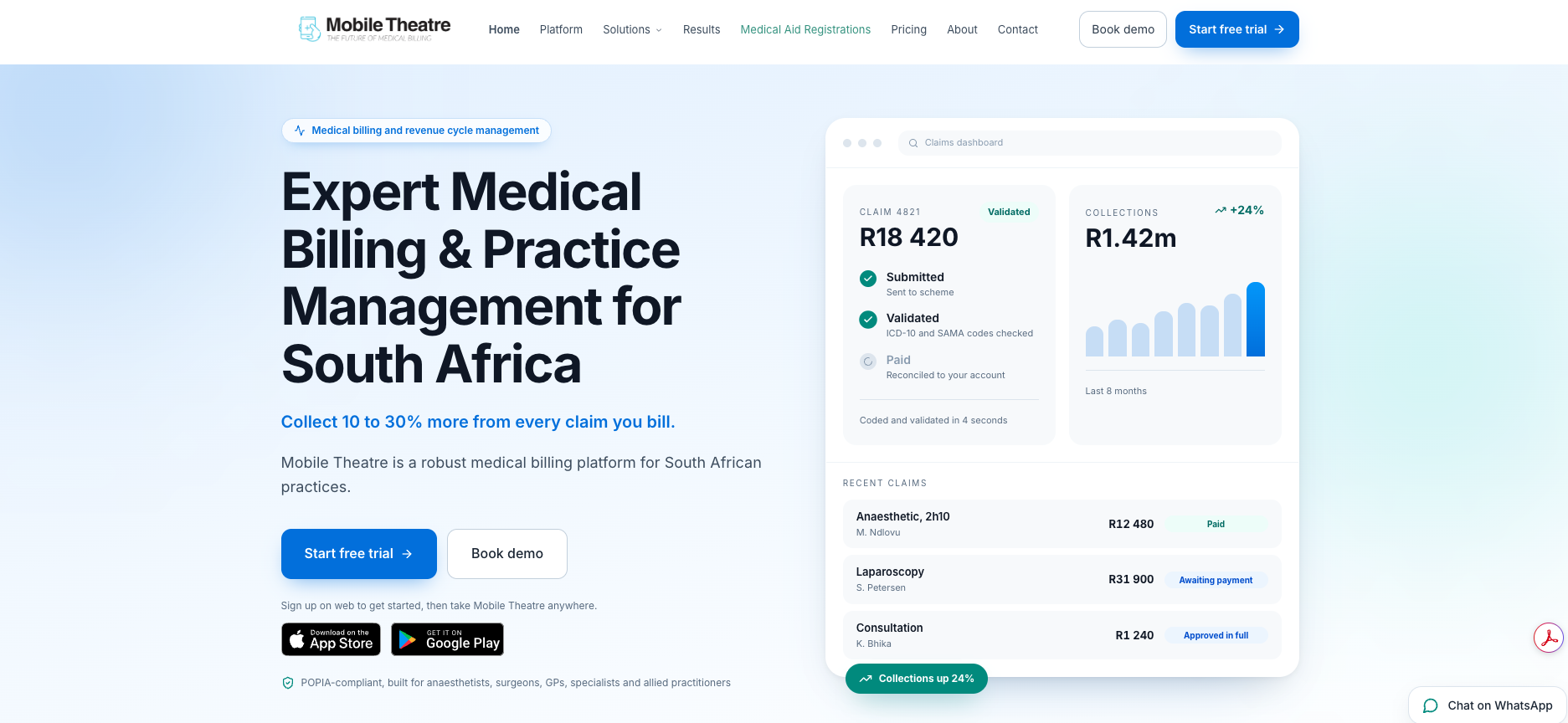
In three months, The Block Group took Mobile Theatre from a website that search engines and AI tools couldn’t read to being recommended by Google’s AI alongside platforms that have led the market for decades. Our first article ranked in Google’s AI recommendations and in Google search within 72 hours of going live.
The big wins
- 72 hours: our first article ranked in Google’s AI recommendations and in Google search within three days of going live.
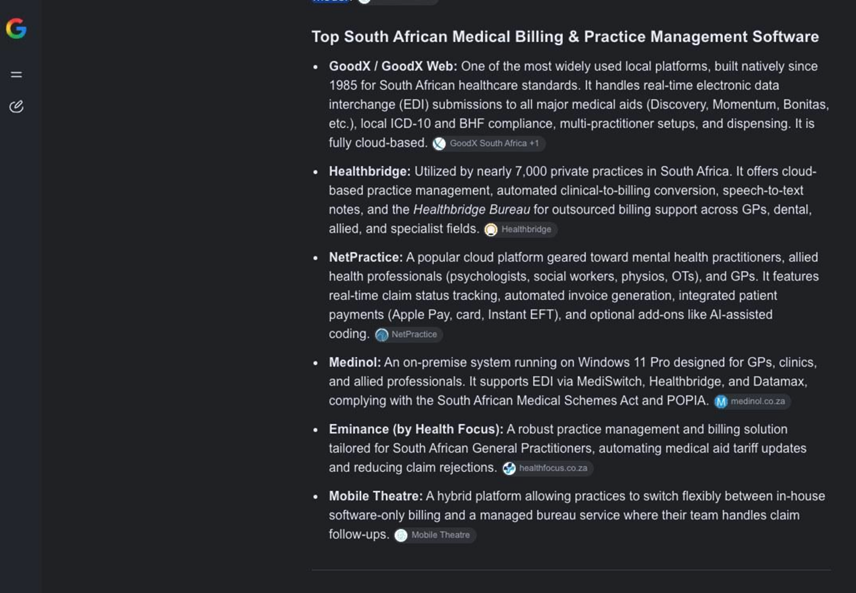
- Top 6 in South Africa: Google’s AI now lists Mobile Theatre among the country’s leading medical billing platforms, next to providers that have been around since 1985.
- +69% search impressions month on month, as Google shows the site to more buyers every week.
- From invisible to visible: a site search engines couldn’t read became one Google and AI tools crawl, trust and quote, all in three months.
At a glance
| Client | Mobile Theatre, a South African medical billing and practice management platform with an in-house billing bureau |
| Industry | Healthcare technology (B2B SaaS) |
| Services | Website rebuild, technical SEO, Answer Engine Optimisation (AEO), structured data, content strategy |
| Timeframe | August to November 2026 (3 months) |
| Starting point | Essentially invisible online: the site was built with an AI website builder on JSON code that search engines and AI tools couldn’t properly read |
| Headline results | First article ranked in Google’s AI recommendations and Google search within 72 hours · Named among the top six medical billing platforms in South Africa by Google’s AI · Search impressions up 69% month on month |
The challenge
When we started in August 2026, Mobile Theatre had a strong product but was essentially invisible online. Its website had been built with an AI website builder on JSON code. It looked fine to visitors, but search engines and AI tools couldn’t properly read, index or quote it. When doctors asked Google or ChatGPT for the best medical billing software in South Africa, Mobile Theatre simply wasn’t in the conversation.
Our audits also found:
- No content AI could cite. The blog had zero articles, so there was nothing answering the questions buyers actually ask.
- Key pages hidden from search. The specialty pages for anaesthetists, surgeons and other target practitioners were set to noindex and held one sentence each.
- Contradictory facts. Pricing and results claims differed between pages, structured data and the homepage. AI systems tend to skip brands they can’t describe consistently.
- Technical issues. A site audit flagged 90 errors and 1,630 warnings, including 9 pages with duplicate meta descriptions.
- No expert voice. Nothing on the site showed the medical expertise behind the product, a key trust signal for health-related content.
Our approach
We built a six-month AEO plan around one goal: make Mobile Theatre easy for search engines and AI systems to find, understand, trust and quote. We spent the first two months on foundations, then published content in month three.
- Rebuild the website in HTML (month 1). We moved the site off the JSON-based AI builder and rebuilt it as a proper HTML website, so every page could be crawled, read and indexed by Google, Bing and AI tools.
- Fix the SEO foundations (months 1–2). We made every important page indexable, removed thin and duplicate pages, and rewrote titles, descriptions and headings.
- One version of the truth (month 2). We aligned pricing, statistics and positioning across every page, the structured data and the business listings, so AI gets the same facts wherever it looks.
- Speak the machines’ language (months 2–3). We added structured data (schema) that defines the company, its people, its pages and its answers, all linked together as one entity.
- Publish citable, expert content (month 3). The first article is expert-authored and answer-first, built the way AI systems prefer to quote, and was pushed to Google and Bing for indexing the day it went live.
What we delivered
| Phase | Work delivered |
|---|---|
| Months 1–2: Rebuild and foundations | Rebuilt the website from a JSON-based AI builder into a crawlable HTML website · Site and AI-readiness audit · Competitor and keyword gap analysis · Six-month AEO action plan · New meta titles, descriptions and H1s for every main page · Fixed hidden and duplicate pages · Aligned pricing and claims across the site · Organisation and local business schema · 45-keyword tracking set covering brand, commercial, specialty and AI-style questions |
| Month 3: Content and authority | Published the pillar guide The Best Medical Billing Software in South Africa: A Practical Guide, authored by a medical doctor · Launched four specialty landing pages (anaesthetists, surgeons, dietitians, physiotherapists) · Redesigned the About page around the Chief Medical and Technical Officer · Article, FAQ, Person and breadcrumb schema · Instant indexing (IndexNow) on Bing and indexing requests in Google Search Console · Creator content guide for a partnership with a leading medical influencer (300,000 followers) |
The guide was also published as a LinkedIn article on Mobile Theatre’s company page and promoted through a Google Business Profile post.
The result
Within 72 hours of publishing, Mobile Theatre’s first article was ranking in Google’s AI recommendations and in Google’s search results. Google’s AI now names Mobile Theatre as one of the top six medical billing and practice management platforms in South Africa.
- 72 hours from publish to recommended: the first article on the rebuilt site was picked up by Google’s AI answers and ranked in Google search within three days. For a site that search engines couldn’t read three months earlier, that’s a complete turnaround.
- In elite company: Mobile Theatre appears alongside GoodX (built since 1985), Healthbridge (used by nearly 7,000 practices, according to the same answer), NetPractice, Medinol and Eminance, all long-established names in the market.
- Described in its own words: Google’s AI describes Mobile Theatre as a hybrid platform that lets practices switch between running billing in-house on the software and a managed bureau. That is exactly the software-or-bureau positioning we built into the article and across the site.
- Cited from the client’s own site: the recommendation links straight to Mobile Theatre, not to a third-party listicle. Google’s AI trusts the content we built as the source.
Results like this usually take six months or more in AEO, especially in a health-related category, where AI systems are most cautious about which sources they quote. Getting the foundations right first is what made a 72-hour result possible.
Early search growth
Google is showing Mobile Theatre to more searchers every week, and the new pages ranked within days of going live. Data from Google Search Console, November 2026.
| Signal | Growth |
|---|---|
| Search impressions, 1–9 November vs 1–9 October | +69% (689 vs 407) |
| Search impressions, last 14 days vs previous 14 days | +31% (882 vs 671) |
| New pillar guide | 234 impressions and an average position of 10 within about two weeks of publishing |
| New surgeons page | Average position 2.3 for the searches it appears in |
| Non-brand searches showing the site | 164 different buyer and research searches, such as “medical billing software south africa”, “billing software” and “cost of medical billing software” |
The site is now ranking for searches from buyers who don’t yet know the brand, which is where new customers come from. That visibility comes before click growth: the next phase moves these pages onto page one.
Why it worked
- We fixed what AI couldn’t see. Rebuilding the site in HTML turned an unreadable website into one search engines and AI tools could crawl and understand. Without that, no amount of content would have ranked.
- Foundations before content. Two months of technical SEO, consistent facts and structured data meant the first article landed on a site Google already trusted, so it ranked in 72 hours instead of months.
- We wrote for how AI answers, not just how Google ranks. The article answers the buyer’s question in its first lines, shows its method, admits trade-offs and compares types of solution. That is the format AI systems prefer to quote.
- Expertise was made visible and machine-readable. A named medical doctor authors the content, and schema ties him, the company and the content together as one trusted entity.